Publisher: Virtual Driver Interactive. Rules checked .
Every Mississippi school district with grades 9 to 12 now has to offer driver education. The next question in many district offices is about equipment. Do you need driving simulators, how many, and which kind?
This guide from Virtual Driver Interactive (VDI) covers what the law and state rules allow, how to size a purchase, and where our simulators fit. It's written for district leaders and CTE directors.
Does SB 2695 require driving simulators in Mississippi schools?
No. Senate Bill 2695 requires every district with grades 9 to 12 to establish and maintain a driver education program, starting in 2026-27. The law doesn't mention simulators.
The hours come from State Board Rule 29.1: 30 classroom hours and six behind-the-wheel hours. A state-approved simulator can change that math. Twelve simulator hours plus three road hours can stand in for the six road hours. That cuts each student's time in the car in half.
Our view: buy simulators when road time is your bottleneck. Buy enough stations to give each student 12 hours in the time you have. And get the Mississippi Department of Education (MDE) to approve your exact system in writing before you count those hours.
Here's how the pieces connect. A student who freezes at a busy intersection needs more reps before the car. In a simulator, they can run that scene again while you check their scores and coach the next try. That practice is what can earn simulator credit, and it frees the car for the three road hours that remain. It won't replace all road time, and your rules still decide what counts. Our Novice Driving Essentials (NDE) curriculum page lists the 14 lessons and the instructor reports we'd put in that room.
Why road time is the bottleneck for SB 2695
Under Rule 29.1, each student needs six hours behind the wheel. Each of those hours ties up a trained instructor and a car with dual controls. Classroom hours scale easily. Road hours don't.
The numbers are large. Brian McGairty, who directs MDE's Office of Safe and Orderly Schools, told the Mississippi Free Press that about 32,000 sophomores start in 2026-27. He also noted the law only requires districts to offer the course. He described how simulators fit that gap:
"It's a very expensive piece of technology, but without that technology, it's going to be very difficult to really offer more than one or two classes a year with a limited number of instructors."
He also said an MDE request for information put simulator prices "north of $10,000 per unit." So the real question isn't whether simulators help. It's how many you need to make the price worth it.
Same road time, twice the students
Here's a planning example, not a forecast. Say one instructor and one car can deliver 240 road hours in a school year. At six road hours per student, that serves 40 students. On the simulator route, at three road hours each, the same car serves 80.
Students served by 240 road hours a year, by plan
Hypothetical example. Unit: students per school year. Based on Mississippi Rule 29.1 hour options, checked November 6, 2026.
| Plan | Road hours per student | Simulator hours per student | Students served | Simulator hours needed |
|---|---|---|---|---|
| Road only | 6 | 0 | 40 | 0 |
| Simulator route | 3 | 12 | 80 | 960 |
Source: hour options from 7 Miss. Code R. 3-29.1. Chart by Virtual Driver Interactive. The 240-hour figure is an assumption for illustration.
Here's the tradeoff. Those 80 students also need 960 simulator hours. The car stops being the bottleneck, and the simulator room takes its place. That's why station count matters as much as unit price.
What Mississippi rules let a simulator replace
Rule 29.1 gives schools three ways to meet the six-hour road requirement. Only one of them uses simulators alone to cut car time.
| Option | Road time per student | Simulator or range time | Watch for |
|---|---|---|---|
| Road only | 6 hours behind the wheel | None | Needs the most car and instructor time. |
| Simulator route | 3 hours behind the wheel | 12 hours in a state-approved simulator (4 to 1, up to 3 hours replaced) | The simulator must be state approved. |
| Range and simulator mix | At least 2 hours on the street | Multi-car range at 2 to 1, simulator at 4 to 1 | Range time needs MDE approval in advance. |
There's a fourth use. Twelve simulator hours may count as classroom time instead, if they aren't used to replace road time. That adds practice, but it doesn't free up the car.
Who approves the simulator?
The rule credits only a "State approved simulator." As of November 2026, we haven't found a public MDE approval for a specific VDI system. Ask MDE's Office of Safe and Orderly Schools to confirm in writing which model and software qualify, and for which option.
Two other rule details matter for buyers. Teachers who lead simulator lessons "must show evidence of proper training in use of the equipment." And parts of Rule 29.1 still describe state-owned mobile simulators and a form, DE-2, to request one. Ask MDE whether any of that still applies.
Our guide to Mississippi simulator credit walks through the 12-for-3 swap and the approval questions in more detail. For eligibility, teacher endorsements, and key dates, see our Mississippi driver ed requirements guide.
How many simulator stations does a Mississippi school need?
Start with the hours, not the hardware. Here's the math we'd use with a district team:
- Multiply students by 12. A class of 20 needs 240 simulator hours.
- Estimate usable time per station each day. Logins, seat changes, and coaching eat into a class period. Our example uses 45 minutes.
- Divide. Simulator hours needed, divided by station hours per day, gives the school days one class will take.
| Stations | Station hours per day | School days to finish one class of 20 | Classes of 20 per year |
|---|---|---|---|
| 4 stations | 3 | 80 | 2 |
| 6 stations | 4.5 | 54 | 3 |
| 8 stations | 6 | 40 | 4 |
| 10 stations | 7.5 | 32 | 5 |
Days are rounded up. Classes per year are rounded down. Change the inputs to match your bell schedule.
Look at the first row. Four stations bring you right back to about two classes a year, the limit McGairty described. In this example, six to eight stations is where the purchase starts to pay off in seats.
Our view: plan for at least six stations per simulator room if you want three or more classes a year. If two schools will share units, plan the schedule first, then the moving. Our step-by-step guide to adding simulators to a school program covers rotations, space, and pilot planning.
Desktop or full cab: which simulator fits your school?
VDI offers two hardware lines. Both run our training courses, including NDE. The choice comes down to room space, how often units move, and how car-like you want the seat to feel.
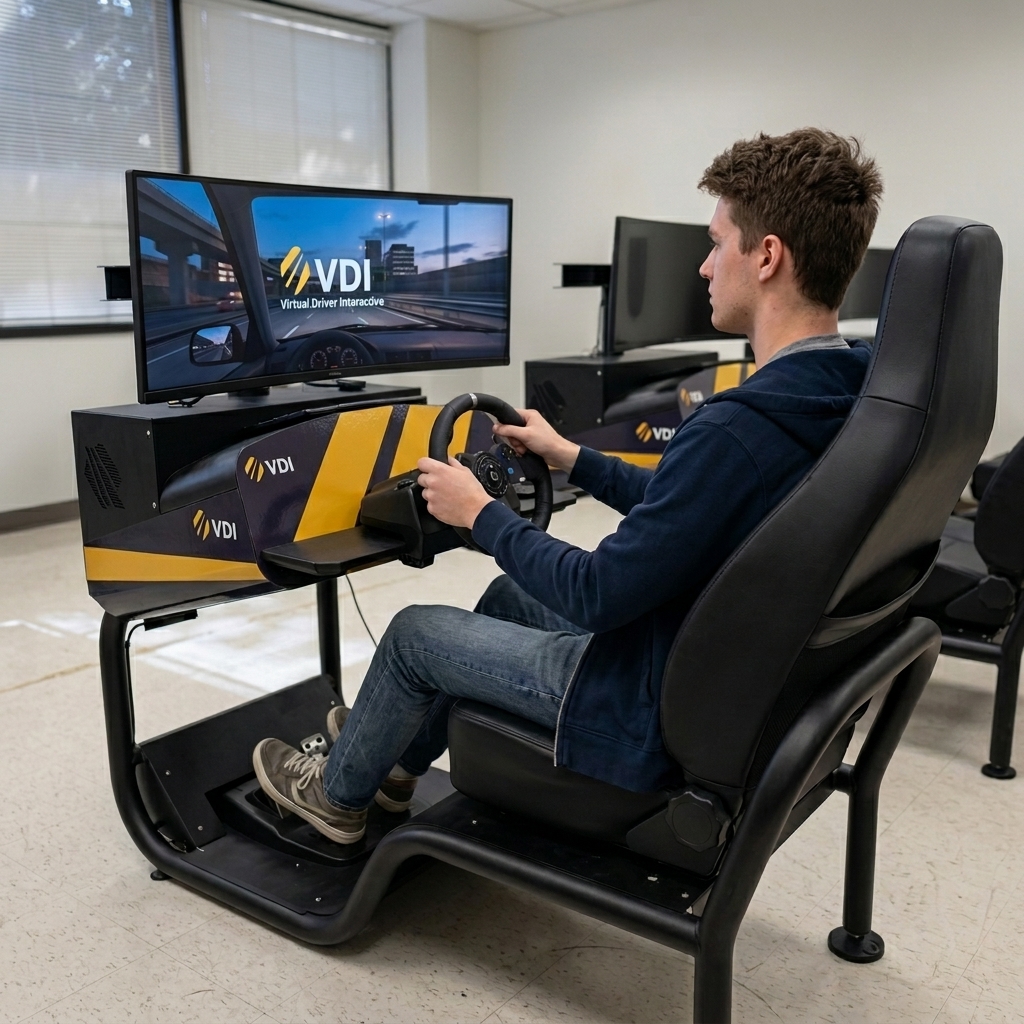
| Feature | Desktop Series | Full Cab Series |
|---|---|---|
| Models | dVT34C and dVT49C | LX49C |
| Screen | dVT34C: 34-inch curved HD monitor | 49-inch ultra-wide curved HD monitor |
| Controls | Full-size steering wheel and pedals at a desk | Adjustable car seat, seat belt, mounted steering wheel, gas and brake pedals |
| Setup and moving | Compact for limited space. dVT34C fits optional travel cases. | Self-contained. Plug it in. Fits inside a standard trailer. |
| Best fit | Rooms where you need more stations in less space, or units that rotate between schools | A dedicated driver ed room where a car-like seat matters most |
On price, our hardware options page lists complete systems starting at $9,900, including software. Pricing depends on program size, hardware setup, and deployment. That's close to the "north of $10,000 per unit" MDE heard in its request for information.
Our view: station count drives capacity, so most high schools should start by asking how many desktop stations their room holds. Add a full cab if you want a car-like seat for your newest drivers. Ask for quotes on more than one mix before you decide.
How NDE fits a Mississippi driver ed course
NDE is our driver education curriculum for school programs. It has 14 lessons and takes about three hours of simulation time. Every student starts with a baseline assessment, so you can see skill gaps before training begins.
The lessons cover hazard detection, intersections, signaling, following distance, space management, sharing the road, weather and road conditions, distracted driving, and parking. A post-assessment and free drive close it out. Our Vantage reporting tool shows lesson completion, time on task, scores, assessment results, and key driving behaviors.
Where NDE fits, and where it doesn't
McGairty told the Mississippi Free Press that MDE's revised curriculum, rolling out this fall, includes units on rules of the road, law enforcement interactions, and distracted driving. NDE's lessons line up with the rules-of-the-road and distracted driving work. NDE has no traffic-stop lesson, so that unit stays in your classroom.
Here's the gap to plan for. NDE's structured lessons fill about three of the 12 simulator hours. The rest would come from repeat lessons and free drive practice. Ask MDE whether repeat practice counts before you build your schedule around it.
What a larger rollout looks like
Baldwin County, Alabama added 48 VDI simulators across eight high schools in 2023. That's an average of six per school, right in the range of our station table. Alabama's rules differ from Mississippi's, so treat it as a size example, not a credit example.
"The equipment is top notch, and the people are kind, understanding, and extremely helpful."
A simulator buying checklist for Mississippi districts
Use this list when you write a quote request or sit in on a vendor demo. It works for any simulator brand, including ours.
Mississippi driver ed simulator buying checklist
For district leaders and CTE directors. Based on Rule 29.1 and SB 2695, checked November 6, 2026.
Before you request quotes
- Name your bottleneck: instructors, cars, road hours, or room space.
- Pick your hour option: simulator route or classroom credit.
- Ask MDE in writing which model and software count as state approved.
- Measure the room and check outlets. The rule flags power needs for simulators.
During the demo
- Have your teacher drive one lesson, then read the report.
- Ask how each student reaches 12 hours and what records show it.
- Ask what teacher training comes with the system.
- Check how fast students can switch seats between turns.
In the quote
- Itemize hardware, software and licensing, delivery, setup, and training.
- Add support, updates, warranty, and replacement parts.
- Ask about moving units between schools.
- Price a one-school pilot and a full rollout.
Sources: 7 Miss. Code R. 3-29.1 and SB 2695 (2024). Checklist by Virtual Driver Interactive.
How to pay for simulators while state money is pending
MDE asked lawmakers for about $30 million, and McGairty said most of it was for driver education simulators. In July, he said the request hadn't been funded. MDE plans to keep asking for 2027.
Rule 29.1 still describes per-pupil reimbursement and a yearly cost report, form DE-4. Ask MDE whether any reimbursement is funded for 2026-27 before you build it into your budget.
Our view: run a one-school pilot first. Buy enough stations for one class, track road hours saved for a semester, and use that data in your next budget request. It's a stronger case than a vendor quote alone.
Key takeaways for Mississippi district buyers
- SB 2695 requires districts with grades 9 to 12 to offer driver ed from 2026-27. It doesn't require simulators.
- Under Rule 29.1, 12 hours in a state-approved simulator plus 3 road hours can replace the 6 road hours.
- That route can double the students one car serves, but it needs 240 simulator hours per class of 20.
- Four stations may still cap you near two classes a year. Six to eight stations give more room in our example.
- Get MDE's approval for your exact system in writing, and confirm funding before you count on it.
Frequently asked questions
Does Mississippi require schools to buy driving simulators?
No. SB 2695 requires districts with grades 9 to 12 to establish and maintain a driver education program starting in 2026-27. The law doesn't mention simulators. Rule 29.1 lets schools use a state-approved simulator to cover part of the road-time requirement.
Can a simulator replace all six behind-the-wheel hours in Mississippi?
No. Simulator time can replace up to three road hours, at four simulator hours for each road hour. Under any mix of simulator, range, and road time, students still need at least two hours of on-street driving.
How much does a driver's ed simulator cost?
MDE's McGairty said a state request for information put prices "north of $10,000 per unit." The full cost also includes software, setup, training, support, and warranty. Ask every vendor for an itemized quote.
Do teachers need training to run simulator lessons?
Yes. Rule 29.1 says teachers who instruct in the simulation phase must show evidence of proper training on the equipment. Ask vendors what training they include, and ask MDE what proof it accepts.
Plan your simulator purchase around road time
Start with your road-hour gap, size the station count to close it, and get MDE's approval in writing. Then pick the hardware. If you'd like to talk through those numbers for your district, we'll show you NDE in action and answer your setup questions.
Tell us about your Mississippi district
Share your enrollment, schools, and start date, and we'll get back to you.
Sources
- Mississippi Legislature. Senate Bill 2695 conference report, 2024 Regular Session.
- Mississippi State Board of Education. 7 Miss. Code R. 3-29.1, Driver Education, via Cornell Legal Information Institute.
- Mississippi Department of Education. Driver Education, Office of Safe and Orderly Schools.
- Torsheta Jackson, Mississippi Free Press. Mississippi Now Requires Driver's Education in All Schools, But Funding Gaps Leave Districts Scrambling, July 28, 2026.
- Virtual Driver Interactive. Novice Driving Essentials.
- Virtual Driver Interactive. Hardware Options.
- Virtual Driver Interactive. Driving Simulators for Mississippi Schools (Baldwin County rollout and testimonial).
Media credits
Photo: VDI Full Cab Series simulator, Virtual Driver Interactive. Chart, tables, and checklist: original by Virtual Driver Interactive from the sources above. Capacity and station figures are hypothetical planning examples.