Published by Virtual Driver Interactive
In October 2025, during Teen Driver Safety Week, the Minnesota State Patrol rolled out two new driving simulators from Virtual Driver Interactive (VDI). Troopers bring them to schools and community events. Teens get to feel what a glance at a phone does to their driving, and nobody gets hurt.
So how does the State Patrol use them? Each simulator offers 17 lessons, including distracted driving, impaired driving, and "what if" rules-of-the-road scenarios, according to the Minnesota Department of Public Safety. A drive lasts about two to five minutes, and it ends the moment the teen crashes.
Troopers use the simulators at schools, recruiting events, and community outreach programs. They run VDI's Distracted Driving Experience (DDE), which puts drivers in scenarios with texting, calls, navigation, and impairment. In our view, the drive is only half the lesson. The talk that follows turns a crash on screen into a choice a teen can make on a real road.
Here's how the pieces fit. A teen picks up a phone mid-drive and drifts over the center line. A trooper watching the screen asks one question: what pulled your eyes away first? That question links practice to review. It also shows the limit: one drive builds awareness, but it doesn't prove a teen will drive safer next month.
Running outreach for an agency? Our Distracted Driving Experience product page shows the scenarios and the driving errors DDE captures in real time. It also covers desktop and full cab hardware.
What the Minnesota State Patrol rolled out
The State Patrol has two simulators. The Minnesota Department of Public Safety (DPS) says teens like them because the lessons feel like a video game. That pull matters at a busy school assembly, where a line forms on its own.
Each simulator includes DDE's two drives. The distracted drive asks teens to handle texts, phone calls, and GPS inputs while they steer. The impaired drive shows how alcohol and drugs slow a driver's response.
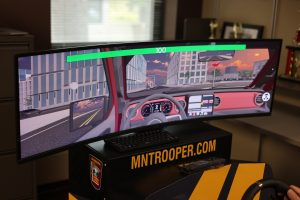
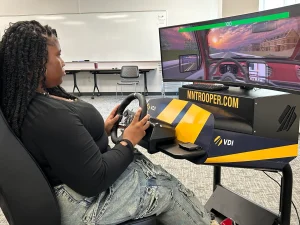
Trooper Chris Caldwell helped show the program. His daughter, Khiarra, had just earned her license.
"Crashes are the leading cause of death for teens in Minnesota and across the U.S., and nearly all of those crashes are preventable. New drivers don't yet have the skills experienced drivers develop over time, so extra guidance and practice matter."
Trooper Chris Caldwell, Minnesota State Patrol, via Minnesota DPS
Why Minnesota is focusing on teen drivers
Teens show up in crashes far more often than their numbers suggest. In 2023, Minnesota drivers ages 15 to 19 were 6 percent of licensed drivers. Yet they were in 11 percent of reported crashes, DPS reports.
The state's 2023 Minnesota Motor Vehicle Crash Facts report adds detail. It counted 11,702 drivers ages 15 to 19 in crashes and 42 in fatal crashes. That year, 29 people ages 15 to 19 died on Minnesota roads and 2,662 were injured.
The national picture looks similar. In 2024, 2,320 people died in crashes involving a teen driver. Of those, 752 were the teen drivers, according to NHTSA's Teen Driver Safety campaign page.
DPS names five big risks for teens: distractions, speed, skipped seat belts, impairment, and passengers. Minnesota law bars anyone under 21 from driving after drinking any alcohol. It also limits passengers for newly licensed teens. A simulator can put two of those risks, distraction and impairment, in front of a teen in a few minutes.
What a distracted driving simulator can and can't show
There's Minnesota research on this exact setting. At the Minnesota State Fair, University of Minnesota researchers ran 193 people through simulated drives. Their study in Communication Research Reports found that texting drivers crashed, crossed the fog line, and sped more than drivers who weren't distracted. Afterward, participants reported being less likely to drive distracted.
That's useful, and it has limits. The study measured what people said they'd do, right after one session. It didn't track crashes later on. A simulator drive is an awareness tool. It isn't proof of long-term behavior change.
Simulation also complements required driver education and behind-the-wheel training. It doesn't replace them. Teen licensing rules differ by state, so check your state's current requirements before you plan a program.
How to run a teen simulator session that sticks
Our view: plan the debrief before you plan the line. A teen who crashes and walks away has a story. A teen who crashes and answers one good question has a lesson. Here's a simple plan you can adapt.
| Step | Time | Who leads | What to do |
|---|---|---|---|
| 1. Set one goal | Before the event | Program lead | Pick one behavior, like "phone stays down." Match it to your state's teen driver laws. |
| 2. Drive | 2 to 5 minutes | Teen, with a trooper or instructor watching | Let the drive end on its own. Note the first error: a lane drift, a missed stop sign, a late brake. |
| 3. Debrief | About 2 minutes | Trooper or instructor | Ask what pulled the teen's eyes away first. Then ask what they'd do on a real road. |
| 4. Follow up | After the event | School, parents | Send home a short note on the goal. Ask driver ed teachers to bring it up in class. |
Worked example (hypothetical): Say you bring two simulators to a 50-minute class period. If each turn takes about 5 minutes, including the debrief and seat swap, each station serves about 10 students. That's about 20 students per period.
The tradeoff is real. Cut the debrief and you'll serve more students, but each one leaves with less. For a big assembly, we'd let a few volunteers drive on a shared screen and debrief the whole room at once.
Key takeaways
- The Minnesota State Patrol uses two simulators with 17 lessons, including distracted and impaired driving, at schools and community events.
- Each drive lasts about two to five minutes and ends at the first crash.
- Minnesota teens ages 15 to 19 were 6% of licensed drivers but were in 11% of reported crashes in 2023.
- Research shows simulators can shift what people say they'll do. It doesn't show a lasting drop in crashes.
- A short debrief question does more than a longer line of drivers.
Frequently asked questions
What simulators does the Minnesota State Patrol use?
The State Patrol uses two simulators that run VDI's Distracted Driving Experience. According to DPS, they offer 17 lessons, including distracted driving, impaired driving, and rules-of-the-road scenarios.
Can a driving simulator replace driver's ed?
No. Simulation complements required classroom and behind-the-wheel instruction. Requirements differ by state, so check your state's current rules.
How can a Minnesota school get the State Patrol simulators?
The State Patrol takes event requests through its Request the State Patrol for an event page. Availability depends on the patrol's schedule.
Plan your next teen outreach
This year's Teen Driver Safety Week runs October 18 to 24, 2026, per NHTSA. If your agency wants a program like Minnesota's for next school year, start with the goal and the debrief. Then see whether DDE fits your events.
Request a DemoQuestions? Call 877-746-8332 or email sales@driverinteractive.com. Learn more about our simulators for law enforcement.
Sources
- Minnesota Department of Public Safety. Teens learn road safety with virtual crashes and real lessons. Oct. 22, 2025.
- Minnesota Office of Traffic Safety. Minnesota Motor Vehicle Crash Facts 2023. 2025.
- NHTSA Traffic Safety Marketing. Teen Driver Safety. Accessed Oct. 19, 2026.
- Downs, E., et al. Fair Game: Using Simulators to Change Likelihood of Distracted Driving at the Minnesota State Fair. Communication Research Reports, 35(2), 121 to 130.
- Minnesota Office of Traffic Safety. Teen driver laws. Accessed Oct. 19, 2026.
- Virtual Driver Interactive. Distracted Driving Experience. Accessed Oct. 19, 2026.
Media credits
- Simulator photos: Minnesota State Patrol, Minnesota Department of Public Safety.
- Chart and session planner: Virtual Driver Interactive, from the sources above.